When people talk about northern Vietnam, Hanoi often takes center stage. But just a short journey south lies a destination that quietly steals the hearts of travelers who seek depth, calm, and authenticity. Ninh Binh Vietnam is not a place you rush through—it is a place you slow down for, breathe deeply in, and remember long after you leave.
You May Also Like:
Often described as “Ha Long Bay on land,” Ninh Binh Vietnam offers far more than dramatic limestone karsts. It is a province where ancient capitals sleep beneath mountains, where rivers glide through rice fields, and where daily life continues in harmony with nature. Visiting Ninh Binh Vietnam feels less like sightseeing and more like stepping into a living landscape shaped by time, culture, and quiet resilience.
An Overview of Ninh Binh Vietnam: Where Geography, Time, and Life Converge
Situated at the southern edge of the Red River Delta, Ninh Binh Vietnam occupies a uniquely strategic and poetic position on the map of northern Vietnam. Located roughly 100 kilometers south of Hanoi, the province is close enough for a short escape from the capital, yet distant enough to feel like another world entirely. Many travelers arrive expecting a quick side trip and leave wishing they had planned for much longer. This is the quiet power of Ninh Binh Vietnam—it reveals itself slowly.
Despite covering an area of only about 1,400 square kilometers, Ninh Binh Vietnam contains a remarkable density of landscapes and landmarks. Limestone karsts rise abruptly from flat rice plains, rivers carve pathways through mountains, wetlands stretch into open horizons, and ancient temples rest where history once unfolded in dramatic fashion. Few destinations in Southeast Asia offer such a seamless combination of natural beauty and historical significance within such a compact area.
Home to just over one million residents, Ninh Binh Vietnam maintains a calm, grounded rhythm of life. Here, agriculture remains central, with rice paddies, lotus ponds, and vegetable fields shaping the visual identity of the countryside. At the same time, tourism has developed steadily but not aggressively, allowing traditional villages, crafts, and customs to remain visible rather than staged. This balance is one of the defining characteristics of Ninh Binh Vietnam: progress without erasure.
What sets Ninh Binh Vietnam apart from many other destinations is how effortlessly its geography, climate, and cultural history intertwine. The land itself feels intentional, as if the mountains rose where they were needed, and the rivers flowed where people could thrive. This harmony is not accidental—it is the result of centuries of coexistence between humans and nature.
Climatically, Ninh Binh Vietnam experiences a tropical monsoon pattern typical of northern Vietnam, yet its landscapes respond to the seasons in particularly dramatic ways. Summers are warm and humid, often reaching high temperatures, but they also bring intense vitality. Rice fields glow green, lotus flowers bloom across wetlands, and rivers reflect endless shades of emerald. In contrast, winter transforms the region into something quieter and more introspective. Cooler temperatures and morning mist soften the limestone peaks, giving Ninh Binh Vietnam a dreamlike, almost mythical atmosphere. Each season reshapes the experience, offering visitors a different emotional connection to the land.
The Historical Soul of Ninh Binh Vietnam: Where the Nation Once Began
To truly understand Ninh Binh Vietnam, it is essential to understand its role as one of the cradles of Vietnamese statehood. Long before Hanoi became the capital, this land held the political and symbolic heart of the nation. In the 10th century, the ancient capital of Hoa Lu served as the seat of power for the Dinh Dynasty, the Early Le Dynasty, and the early Ly Dynasty—three pivotal periods in Vietnam’s journey toward independence and unity.
Hoa Lu was not chosen by chance. Surrounded by rugged limestone mountains and protected by natural waterways, it offered a nearly impenetrable defensive position. These same mountains that now attract photographers and travelers once shielded the young nation from external threats. Geography and history worked hand in hand here, shaping the destiny of Ninh Binh Vietnam.
Walking through Hoa Lu today is not an experience of ruins in the conventional sense. While much of the original royal citadel no longer stands, the atmosphere remains profoundly intact. Stone pathways lead past moss-covered gates and into temple courtyards where incense smoke curls gently into the air. The temples dedicated to King Dinh Tien Hoang and King Le Dai Hanh stand quietly, their wooden beams and stone carvings worn smooth by time.
There is a distinct feeling that history in Ninh Binh Vietnam is not confined to museums or plaques. It exists underfoot, in the alignment of mountains, in the layout of villages, and in the rituals that continue to be practiced during festivals. Locals speak of Hoa Lu not as a distant past, but as a living inheritance.
The importance of Hoa Lu extends far beyond national borders. It forms one of the core zones of the Trang An Landscape Complex, which UNESCO recognized as a World Heritage Site for its combined cultural and natural value. This designation highlights what many visitors instinctively feel: in Ninh Binh Vietnam, history is inseparable from the landscape that holds it.
Trang An: The Defining Landscape of Ninh Binh Vietnam
Among all the destinations in Ninh Binh Vietnam, Trang An stands as its most iconic and immersive experience. Often described as the soul of the province, Trang An is not merely a scenic attraction—it is a journey through space, silence, and time.
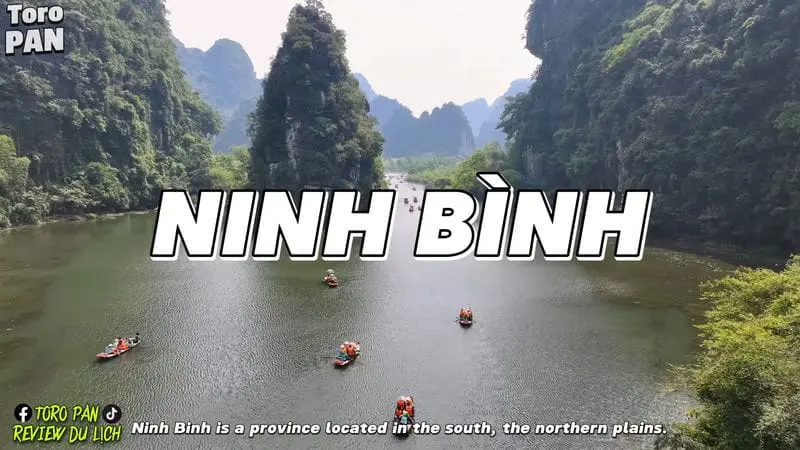
The experience begins simply. You step into a small wooden boat, guided by a local rower, and push away from the dock. Almost immediately, the world becomes quieter. The water is calm, its surface reflecting the limestone cliffs so perfectly that the line between earth and sky seems to dissolve. As the boat glides forward, towering karst formations rise on both sides, their sheer faces streaked with vegetation.
What makes Trang An in Ninh Binh Vietnam truly exceptional is its network of waterways and caves. The boat passes seamlessly from open valleys into dark tunnels, where the temperature drops and the sound of dripping water echoes softly. Some caves stretch long and narrow, requiring patience and stillness; others open suddenly into hidden lagoons bathed in natural light. Each transition feels symbolic, as if moving between different chapters of the landscape’s story.
Unlike many popular natural attractions, Trang An retains a sense of scale and calm. Boats are spaced thoughtfully, and the environment encourages quiet observation rather than spectacle. The dominant sounds are the splash of oars, the rustle of wind against rock, and the distant call of birds. This atmosphere of contemplation is central to the Trang An experience and to the broader identity of Ninh Binh Vietnam.
Beyond its beauty, Trang An holds deep historical significance. Archaeological evidence suggests that humans inhabited these caves thousands of years ago, adapting to changing sea levels and climates. In this way, Trang An is not only a natural wonder but also a record of human resilience—one more layer in the complex story of Ninh Binh Vietnam.
Van Long Wetland: A Sanctuary of Stillness in Ninh Binh Vietnam
For travelers drawn to silence rather than spectacle, Van Long Wetland Nature Reserve offers one of the most meditative experiences in Ninh Binh Vietnam. Often called “the bay without waves,” Van Long is defined by stillness. The water here is so calm that it acts as a perfect mirror, reflecting clouds, mountains, and reeds with astonishing clarity.
Arriving at Van Long feels like entering a protected world. There are no engines, no loud crowds—only bamboo boats gliding gently across the wetland. As you float forward, limestone cliffs appear to rise directly from the water, their reflections doubling their height. The sense of space is expansive, yet intimate.
Van Long is also one of the most important ecological sites in Ninh Binh Vietnam. It serves as a habitat for numerous bird species, including migratory birds that rest here during seasonal journeys. If you are observant, you may spot the endangered Delacour’s langur resting on the cliffs—a rare and humbling sight.
What sets Van Long apart is its refusal to perform. Nature here does not announce itself with drama; it exists quietly, confidently. This creates an experience that feels deeply restorative. Many visitors find themselves speaking in hushed tones, as if instinctively respecting the calm.
Visiting Van Long during lotus season, typically in late spring and early summer, adds another sensory layer. Lotus flowers bloom across the wetland, their soft pink petals contrasting with deep green leaves. The air carries a faint floral scent, and the scene feels almost ceremonial. It is moments like these that define Ninh Binh Vietnam—not as a destination to conquer, but as a place to absorb.
Photography in Van Long often feels effortless. Every angle seems composed, every reflection intentional. Yet no photograph truly captures the sensation of drifting across still water, surrounded by silence, in one of the most peaceful corners of Ninh Binh Vietnam.
A Lasting Impression of Ninh Binh Vietnam
Across its landscapes, history, and wetlands, Ninh Binh Vietnam offers something increasingly rare in modern travel: depth without distraction. It is a place where beauty does not demand attention, but rewards it. Whether standing among ancient temples in Hoa Lu, drifting through the caves of Trang An, or floating across the mirrored waters of Van Long, you are constantly reminded that this land has been shaped by patience—geological, historical, and human.
To visit Ninh Binh Vietnam is not simply to see a series of attractions. It is to experience a region where time feels layered rather than linear, where nature and culture speak the same language, and where stillness itself becomes a form of discovery.
Dong Chuong Lake: Escaping Into Pine Forests in Ninh Binh Vietnam
Tucked away in the Nho Quan district, far from the busier tourist corridors, Dong Chuong Lake reveals a quieter, more introspective side of Ninh Binh Vietnam. This is not a place of grand limestone cliffs or ancient temples, but one of subtle beauty—where pine forests meet still water, and time seems to move at a different pace.
The first thing that surprises many visitors is the atmosphere. Surrounded by gently rolling hills covered in pine trees, Dong Chuong Lake feels almost alpine, an unexpected contrast to the karst landscapes most commonly associated with Ninh Binh Vietnam. The scent of pine needles lingers in the air, and the landscape opens up in wide, breathable spaces rather than dramatic vertical formations.
Dong Chuong Lake is not designed for spectacle. There are no crowds, no loud boats, no rigid itineraries. Instead, it offers permission to slow down. Travelers come here to camp by the water’s edge, to wake up with mist rising gently from the lake, or to paddle a kayak across glassy reflections at sunrise. Sitting beneath the pine trees with a cup of coffee, listening to wind move through the forest, feels like a small luxury—simple, but deeply restorative.
During summer, Dong Chuong Lake becomes a particularly welcome retreat in Ninh Binh Vietnam. Golden sunlight dances across the water’s surface, while cool breezes soften the heat of the day. Unlike many destinations that peak with activity, Dong Chuong feels best when nothing much is happening at all. This quietness is precisely its appeal.
Because it remains relatively unknown, Dong Chuong Lake is often overlooked in standard travel itineraries. Yet for those who stumble upon it—or intentionally seek it out—it frequently becomes a highlight of their journey through Ninh Binh Vietnam. It is the kind of place that does not demand attention, but rewards it generously.
Phat Diem Stone Cathedral: Architectural Harmony in Ninh Binh Vietnam
Among the cultural landmarks of Ninh Binh Vietnam, few are as visually and symbolically striking as Phat Diem Stone Cathedral. Located approximately 28 kilometers from Ninh Binh city, this remarkable complex stands as a testament to architectural dialogue rather than domination—where Western religious design and Vietnamese traditional aesthetics coexist in rare harmony.
Constructed over nearly three decades and completed more than a century ago, Phat Diem Cathedral is built almost entirely from stone and ironwood. Its scale is impressive, yet never overwhelming. Unlike Gothic cathedrals in Europe that reach skyward with sharp verticality, Phat Diem spreads outward, grounded and composed, echoing the spatial philosophy of Vietnamese temples and communal houses.
Pagoda-style roofs curve gently above stone walls. Carved columns stand firm and balanced. Courtyards open into calm, symmetrical spaces where light and shadow move slowly throughout the day. Christian iconography appears not as a foreign intrusion, but as something carefully translated into local language and form.
Walking through Phat Diem Cathedral is as much a cultural experience as an architectural one. It reflects how belief systems in Ninh Binh Vietnam have historically adapted rather than replaced one another. Catholicism here did not erase local traditions—it absorbed and expressed them differently.
There is a quiet dignity to the site. Visitors often find themselves lowering their voices, even outside formal worship times. The stone feels cool beneath the hand, the air still. In this calm, Phat Diem Cathedral reveals something essential about Ninh Binh Vietnam: the ability to integrate, to balance difference, and to endure without losing identity.
Cuc Phuong National Park: The Green Heart of Ninh Binh Vietnam
If there is one place that embodies the ecological soul of Ninh Binh Vietnam, it is Cuc Phuong National Park. As Vietnam’s first national park, Cuc Phuong is not only a protected area, but a foundational chapter in the country’s conservation history.
Stretching across the borders of Ninh Binh, Hoa Binh, and Thanh Hoa provinces, Cuc Phuong forms a vast green sanctuary recognized by UNESCO as a biosphere reserve. Entering the park feels like stepping through an invisible threshold—from cultivated landscapes into deep, ancient forest.
Towering trees rise overhead, some thousands of years old. Their roots twist across the ground like living sculptures, and the canopy above filters sunlight into soft, shifting patterns. The air is cooler here, heavier with moisture and the scent of leaves and soil. Trails wind gently through the jungle, inviting exploration rather than challenge.
Cuc Phuong is home to extraordinary biodiversity. Rare primates, endangered reptiles, and countless plant species coexist within its boundaries. For nature lovers, the park offers both education and awe. Rescue centers dedicated to primates and turtles highlight Vietnam’s commitment to protecting its most vulnerable species, adding ethical depth to the visit.
One of the most magical moments in Cuc Phuong—and in all of Ninh Binh Vietnam—occurs in late May during butterfly season. Thousands upon thousands of butterflies gather along forest paths, filling the air with motion and color. White, yellow, and orange wings flutter around visitors, transforming ordinary walks into surreal, fleeting encounters.
This phenomenon lasts only a short time each year, which makes it all the more powerful. It is a reminder that some of the most beautiful experiences in Ninh Binh Vietnam are brief, fragile, and dependent on balance. Cuc Phuong does not entertain—it humbles.
Tam Diep Pineapple Hills: A Hidden Countryside Gem in Ninh Binh Vietnam
Few visitors associate Ninh Binh Vietnam with agricultural landscapes beyond rice fields, which makes the Tam Diep Pineapple Hills an unexpected and refreshing discovery. Often described as a “mini Da Lat,” this area offers rolling terrain, open skies, and a sense of calm that feels far removed from urban life.
Located in the Tam Diep region, the pineapple hills stretch across gentle slopes, their orderly rows creating rhythmic patterns across the land. The air here feels cooler and lighter, and the absence of traffic noise allows nature to dominate the soundscape.
From June to July, the hills enter harvest season. Pineapple plants bear ripe, golden fruit, filling the air with a sweet, unmistakable fragrance. Visitors can walk freely through the fields, take photographs framed by endless greenery, or even join local farmers in harvesting pineapples by hand.
This experience is simple, but deeply grounding. There are no elaborate setups, no curated performances. Just land, labor, and life unfolding at its natural pace. In moments like these, Ninh Binh Vietnam reveals another layer of its identity—one rooted in rural continuity and quiet resilience.
For travelers seeking authenticity rather than spectacle, Tam Diep Pineapple Hills offer a rare chance to connect directly with the agricultural heart of Ninh Binh Vietnam.
Thung Nang: Poetry in Motion in Ninh Binh Vietnam
Hidden within the broader Trang An complex, Thung Nang offers a softer, more intimate expression of Ninh Binh Vietnam. Its name translates roughly to “Valley of the Sun,” and the experience lives up to the poetry implied by the words.
Here, small boats drift along narrow waterways that weave between rice fields, reeds, and modest village homes. Unlike the towering drama of Trang An’s limestone cliffs, Thung Nang feels close, personal, and quietly human. It is less about scale and more about rhythm.
As the boat glides forward, sunlight reflects off the water’s surface, illuminating the surrounding fields in warm tones. Farmers tend their crops nearby, their movements unhurried and familiar. The boundaries between daily life and landscape blur, creating a scene that feels lived-in rather than preserved.
Thung Nang is often divided into two areas: an outer section characterized by open scenery and rural charm, and an inner section where caves introduce moments of shadow and coolness. The transitions are gentle, never abrupt, reinforcing the feeling that this is a place meant to be experienced slowly.
In Thung Nang, Ninh Binh Vietnam reveals its poetic nature. Not dramatic, not demanding—just present. It is a reminder that beauty does not always announce itself loudly. Sometimes it drifts quietly by, inviting you to notice.
Ninh Binh Vietnam: A Landscape That Lingers
From pine forests and stone cathedrals to ancient jungles and sunlit valleys, Ninh Binh Vietnam is not a destination defined by a single image. It is a collection of moods, textures, and moments that reveal themselves gradually.
What unites these places is not grandeur, but balance—between nature and culture, history and daily life, stillness and movement. To travel through Ninh Binh Vietnam is not simply to visit landmarks, but to adjust your pace, sharpen your attention, and allow the land to speak in its own quiet language.
Long after the journey ends, it is often these quieter moments—coffee by a pine lake, drifting through a sunlit valley, walking beneath ancient trees—that remain most vividly in memory.
Temples of Kings Dinh and Le: Honoring Vietnam’s Founders
The Temple of King Dinh Tien Hoang and the Temple of King Le Dai Hanh stand as solemn reminders of Vietnam’s formative years. Located near the ancient capital of Hoa Lu, these temples honor rulers who unified the nation and defended it from invasion.
Built on the foundations of the old royal palace, the temples feature traditional “noi cong ngoai quoc” architecture, stone courtyards, and intricate carvings. Archaeological discoveries here—such as ancient lotus-patterned bricks—add depth to the historical experience.
During festivals, especially in the third lunar month, these temples become centers of cultural activity, drawing visitors from across Ninh Binh Vietnam and beyond.
Kim Son Coast and Con Noi: Ninh Binh Vietnam by the Sea
Many travelers are surprised to learn that Ninh Binh Vietnam has a coastline. The Kim Son coastal area stretches nearly 18 kilometers, offering a completely different landscape from the province’s mountains and caves.
Here, mangrove forests, tidal flats, and grassy dikes create a raw, untouched beauty. Walking along the sea dike at sunset, watching fishermen at work, feels grounding and real.
Con Noi, part of the Kim Son coast, is recognized by UNESCO as part of the Red River Delta Biosphere Reserve. It is home to countless bird species, including rare migratory birds. For eco-tourism enthusiasts, this coastal region reveals yet another layer of Ninh Binh Vietnam’s diversity.
Why Ninh Binh Vietnam Stays With You
What makes Ninh Binh Vietnam unforgettable is not just its scenery, but its atmosphere. This is a place where landscapes feel lived-in, where history is not locked behind glass, and where nature and people coexist quietly.
You don’t just visit Ninh Binh Vietnam—you experience it through boat rides, temple walks, forest trails, and shared moments with locals. It is a destination that rewards patience and curiosity.