In 2024, Nha Trang Vietnam reaches a remarkable milestone: 100 years since its establishment as a township. One hundred years may feel brief in the long sweep of history, but for this coastal city, it marks an extraordinary transformation. From a quiet fishing village where travelers once struggled to find a place to stay, Nha Trang Vietnam has evolved into an internationally recognized beach destination—modern, vibrant, yet still deeply rooted in its coastal soul.
You May Also Like:
Standing today along the palm-lined promenade, with the turquoise bay stretching endlessly ahead, it is difficult to imagine that this city was once described as a place with “hardly any lodging for visitors.” Yet that contrast—between past simplicity and present sophistication—is exactly what makes Nha Trang Vietnam such a compelling place to experience.
Where the Name Nha Trang Comes From: A City Born of Water
Long before it appeared on travel maps or tourism brochures, Nha Trang Vietnam existed as a place shaped almost entirely by water. Rivers flowed gently toward the sea, reeds and wild grasses lined their banks, and daily life followed the rhythm of tides rather than clocks. To understand Nha Trang today, one must first understand this intimate relationship with water—because the city’s very name is rooted in it.
According to historians and cultural researchers, the name Nha Trang is believed to be a phonetic evolution of the Cham words “Ea Trăng” or “Ja Trăng.” These terms were used by the Cham people to describe the Cai River, meaning the river of reeds. This was not merely a geographic description; it was an expression of how the land lived and breathed. The river was not just water—it was livelihood, boundary, and identity.
No one knows precisely when the name Nha Trang entered everyday spoken language. What we do know comes from written records that offer glimpses into the past. In historical documents such as The Geography of Khanh Hoa, the name Nha Trang appears in written form as early as the late 17th century. A Vietnamese map compiled by scholar Đỗ Bá recorded the term “Nha Trang Môn,” meaning Nha Trang Gate. Another map from the same period, titled Giap Ngo Nien Binh Nam Do, referred to “Nha Trang Hải Môn”—the sea gate of Nha Trang.
These references suggest that Nha Trang was initially known not as a town or settlement, but as a gateway—a passage between river and sea. Over time, as communities grew around this natural junction, the name gradually expanded to describe the entire region. Long before tourism, long before urban planning, Nha Trang Vietnam was defined by water: river, coastline, and the quiet flow of life between them.
From Peripheral Land to Forgotten Shore
The history of Khanh Hoa Province spans more than 370 years, dating back to 1653 when the Nguyen Lords incorporated the former Cham territory of Kauthara into Đại Việt. Yet despite this long and layered history, Nha Trang Vietnam remained on the periphery for centuries.
During the Nguyen Dynasty, the political and administrative center of the province was not Nha Trang, but Dien Khanh Citadel, located inland. This strategic choice reflected the realities of the time—defense and agriculture mattered more than access to the sea. As a result, Nha Trang remained largely untouched by major development until the late 19th century.
For generations, Nha Trang Vietnam was little more than a quiet fishing village. Its population was sparse, its buildings modest, and its role in regional affairs minimal. The sea provided fish; the river provided water; and beyond that, there was little to draw outsiders.
What we know of this period comes largely from rare visual and written records. In 1894, the renowned French-Swiss doctor and explorer Alexandre Yersin photographed the Nha Trang coastline. His images reveal a strikingly empty landscape: a wide, untouched beach, a few fishing boats anchored offshore, and scattered wooden houses barely visible against the horizon.
A few years later, in 1902, photographs of Xom Con—one of the earliest residential areas—showed clusters of low-roofed homes lining a narrow road. Across the bay, La San Hill rose quietly, watching over a settlement that still felt provisional, almost temporary.
Life Before Tourism Existed
Perhaps one of the most vivid accounts of early Nha Trang Vietnam comes from Madame Vassal, who lived in the area between 1904 and 1907. In her memoir Three Years in Annam, published in 1910, she described Nha Trang as a fishing village of approximately 3,000 residents.
At the time, there were only 20 to 30 Europeans living in the area, most of them employed by the French colonial administration. Despite being considered the administrative center for Europeans in Khanh Hoa, Nha Trang was far from developed.
Accommodation was almost nonexistent. According to Madame Vassal, travelers had difficulty finding a place to stay. There was reportedly only one Chinese-run restaurant, and even that establishment offered just a single guest room. The concept of tourism—as leisure travel—had not yet arrived. Visitors came out of necessity, not curiosity.
In those days, Nha Trang Vietnam was not a destination. It was a stopover, a shoreline, a place that existed quietly outside the currents of change.
1924: The Moment Everything Changed
The transformation of Nha Trang Vietnam began decisively on June 11, 1924, when King Khai Dinh issued a royal decree officially establishing Nha Trang as a township. The newly designated township encompassed the lower reaches of the Cai River and the coastal area facing the East Sea.
This decision was formally approved by the Governor-General of Indochina on August 30, 1924, marking the moment when Nha Trang transitioned from an informal settlement into a recognized administrative entity.
At the time of its founding, Nha Trang Vietnam consisted of just four villages:
- Xuong Huan
- Phuong Cau
- Van Thanh
- Phuong Sai
Though modest in scale, the township immediately began to change. French colonial authorities invested in permanent infrastructure, leaving behind architectural markers that would shape the city’s identity for decades.
Key constructions included:
- Nha Trang Post Office
- Nha Trang Hospital
- Nha Trang Railway Station
- Beau Rivage Hotel, an elegant seaside establishment that hinted at a new future
These buildings introduced durability, order, and a sense of permanence previously absent from the area.
The First Shape of Urban Life
As infrastructure developed, urban life in Nha Trang Vietnam slowly took form. Streets emerged. Markets expanded. Residential zones became more defined.
Poet Quach Tan, in his work The Land of Agarwood, offered a detailed snapshot of this early urban arrangement. Vietnamese and Chinese residents tended to cluster between the railway station and Dam Market, which quickly became the city’s commercial heart. French residents, by contrast, preferred the coastal strip, living along the beachfront from the Provincial Office (now the Khanh Hoa People’s Committee) to the Grand Hotel.
Yet for all this development, much of Nha Trang Vietnam remained wild. Areas such as Ma Vong and Phuoc Hai were still dominated by forest, particularly wild apricot trees. Large tracts of land lay untouched, waiting for a future that had not yet arrived.
Urbanization was happening—but it was uneven, gradual, and cautious.
From Township to Town: Growth Under Constraint
In 1937, King Bao Dai elevated Nha Trang Vietnam from a township to a town, a status later approved by the French administration. On paper, this was a significant step forward. In reality, the physical city remained small and concentrated.
According to the late Dr. Kieu Xuan Cu, the functional center of Nha Trang during this period revolved around just a handful of streets:
- Tran Quy Cap
- Thong Nhat
- Hoang Van Thu
- Yersin
The beachfront along Tran Phu Street, now one of the most famous coastal roads in Vietnam, was still sparsely populated and primarily inhabited by French residents.
As war spread across the country in subsequent decades, Nha Trang Vietnam expanded slowly but steadily. Despite this growth, the city’s commercial and social life remained anchored around Dam Market.
Neighborhoods such as Xom Moi and Phuoc Hai, located behind the Stone Church, were largely informal settlements. Homes were temporary, infrastructure minimal. Roads connecting Nha Trang to Dien Khanh were narrow, often only wide enough for horse-drawn carts, with rice fields stretching out on either side.
Foundations Beneath the Surface
What is striking about this period in Nha Trang Vietnam’s history is not how fast the city grew, but how quietly its foundations were laid. Even amid hardship, war, and limited resources, the basic framework of the modern city began to emerge.
Markets established patterns of trade. Roads defined movement. Coastal zones hinted at future possibilities. The relationship between the city and the sea—always present—became increasingly central to its identity.
Though few at the time could have predicted it, the once-overlooked fishing village was already on its way to becoming something more.
Becoming a City: Nha Trang After 1975
Following national reunification, Nha Trang Vietnam officially became a city in March 1977. From that point onward, transformation accelerated.
Major infrastructure projects reshaped the urban landscape. The construction of Nguyen Tat Thanh Road to the south and Pham Van Dong Road to the north opened up new gateways to the city. Together with Tran Phu Street, these roads formed what is now considered one of the most beautiful coastal routes in Vietnam, stretching from Cu Hin Pass to Luong Son.
Farmland and gardens gradually gave way to planned urban zones. On April 22, 2009, Nha Trang was officially recognized as a Class I city under Khanh Hoa Province—an acknowledgment of its economic, cultural, and strategic importance.
Experiencing Modern Nha Trang Vietnam: Where Sea, City, and Memory Meet
Arriving in Nha Trang Vietnam today is more than a simple transfer from airport to hotel—it is a gradual introduction to a city that reveals itself layer by layer. For many travelers, the journey begins at Cam Ranh International Airport, located south of the city. As the car leaves the airport and heads north, the landscape begins to shift almost immediately.
The road curves through Cu Hin Pass, one of the most scenic coastal approaches in central Vietnam. On one side, mountains rise quietly, covered in scrub and forest. On the other, the sea stretches outward, vast and calm, its color changing with the light—from deep sapphire to pale turquoise. This first impression sets the tone for what Nha Trang Vietnam offers: balance. Nature and development exist side by side, neither fully overpowering the other.
As the city comes into view, the transition feels smooth rather than abrupt. There is no sudden skyline explosion, no sense of being swallowed by concrete. Instead, Nha Trang unfolds gently, as if inviting you in rather than overwhelming you.
First Impressions: A Coastal City That Breathes
Entering the city center, one of the first things visitors notice is the beachfront park that runs parallel to the shoreline. This green corridor acts as a buffer between the sea and the city, preserving a sense of openness that many coastal destinations lose over time.
In the early morning, this area belongs to locals. Elderly residents practice tai chi beneath coconut palms. Joggers move steadily along paved paths. Street vendors prepare small carts of coffee and breakfast snacks. The atmosphere is calm, unhurried, and deeply local.
On one side of the park lies a long stretch of white sand beach, clean and accessible, with the sea never more than a few steps away. On the other side rise rows of hotels, resorts, and serviced apartments—modern, vertical, and increasingly international in style. Yet even here, Nha Trang Vietnam resists becoming anonymous. The buildings may be tall, but they rarely feel oppressive. The sky remains visible. The sea remains dominant.
This coexistence is one of the defining qualities of modern Nha Trang Vietnam: development that acknowledges its setting rather than erasing it.
Offshore Icons and Island Escapes
Looking out from the beach, the horizon is not empty. Several offshore landmarks immediately catch the eye, reinforcing Nha Trang’s identity as a maritime city.
Vinpearl Island, connected to the mainland by cable car, is perhaps the most recognizable. Rising from the water, it represents the city’s resort-driven evolution—luxury hotels, amusement parks, and curated entertainment experiences designed for both domestic and international travelers.
Nearby, Hon Tam Island offers a quieter alternative. Known for its beaches and mud-bath experiences, it attracts visitors seeking relaxation rather than spectacle. Together, these islands illustrate the range of experiences available in Nha Trang Vietnam—from energetic and commercial to tranquil and restorative.
Island-hopping tours are a central part of the Nha Trang experience. Visitors spend days snorkeling, diving, kayaking, or simply floating above coral reefs. Returning to the mainland afterward feels less like leaving nature and more like changing scenes—from open water to urban comfort.
Modern Comforts: Shopping, Dining, and Urban Leisure
Back in the city, Nha Trang Vietnam offers a growing collection of modern amenities that complement its natural appeal. Shopping centers such as Nha Trang Center, Vincom Plaza, and Gold Coast Nha Trang provide air-conditioned refuge from the tropical heat, as well as international brands, cinemas, and food courts.
These spaces are not only for tourists. Locals use them as social hubs—places to meet friends, escape the afternoon sun, or enjoy a leisurely meal. This shared use gives the city a lived-in feel, preventing it from becoming a purely touristic environment.
Dining in modern Nha Trang is equally diverse. International restaurants sit alongside traditional seafood eateries. Rooftop bars overlook the bay, while small family-run establishments continue to thrive in side streets. Even as global influences grow stronger, Nha Trang Vietnam maintains a connection to its culinary roots.
A City Shaped by Events and Collective Experience
Over the past two decades, Nha Trang Vietnam has deliberately cultivated its identity as a city of events. This evolution reflects a broader understanding of tourism—not merely as sightseeing, but as shared cultural experience.
At the heart of this strategy is the Nha Trang Sea Festival, held every two years. More than a celebration, the festival is a statement of identity. It brings together music, art, traditional performances, sporting events, and community activities, all centered around the sea.
During festival periods, the city feels transformed. Streets fill with visitors. Public spaces become stages. Locals and tourists mingle, creating a temporary but powerful sense of collective celebration. The festival does not merely entertain—it reconnects the city with its maritime heritage.
Beyond the Sea Festival, Nha Trang Vietnam has hosted numerous national and international events, including:
- Beauty pageants
- Film and television award ceremonies
- Cultural exhibitions
- Large-scale concerts and performances
These events elevate Nha Trang’s profile beyond that of a beach destination. They position it as a place where culture is actively produced and shared, not simply observed.
The Emotional Geography of the City
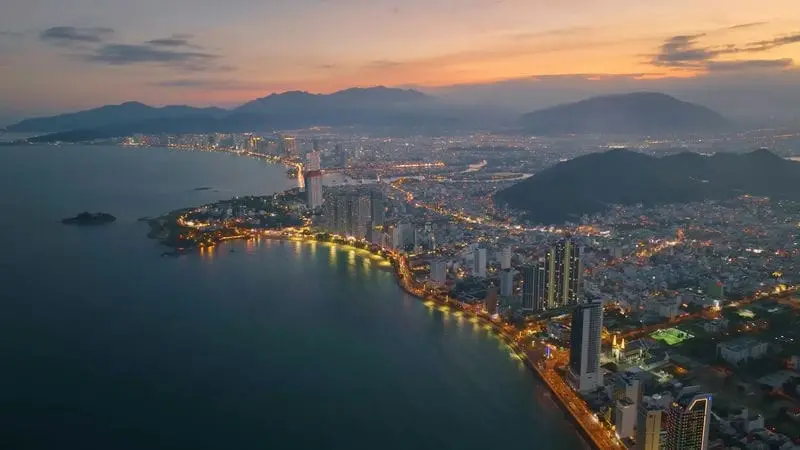
One of the most revealing ways to understand Nha Trang Vietnam is to view it from above. From Co Tien Mountain, the city spreads out in a way that feels both expansive and contained.
The bay curves gently, uninterrupted by industrial sprawl. The sea remains a deep, consistent blue. The urban grid is visible but not dominant. Green spaces still punctuate the cityscape. From this vantage point, it becomes clear that Nha Trang’s growth, while significant, has not erased its natural frame.
This perspective helps explain why many long-term residents feel that the city has retained its soul. Development has occurred, but it has not completely overwritten memory.
Holding Onto Identity in a Changing City
For returning visitors—especially those who first experienced Nha Trang decades ago—the changes can be striking. New buildings stand where fields once stretched. Roads have widened. The population has grown. And yet, something familiar remains.
The beachfront park is still open and green. The coastline remains accessible, not hidden behind private walls. Locals still gather in public spaces rather than retreating indoors. The rhythm of daily life, though faster, remains gentler than in Vietnam’s largest metropolitan centers.
Hospitality continues to define the city. Residents of Nha Trang Vietnam are widely known for their friendliness, their willingness to help, and their calm demeanor. Conversations with shop owners, drivers, or café staff often feel unforced and genuine.
Many longtime residents acknowledge the city’s transformation with a mix of pride and caution. There is pride in seeing Nha Trang recognized internationally, in watching it host major events and attract global attention. There is also an awareness that growth must be managed carefully.
Toward a Sustainable Future
Today, both the provincial government and city leadership emphasize sustainable and green development as the guiding principle for Nha Trang’s future. Urban planning increasingly focuses on:
- Environmental protection
- Green spaces
- Sustainable tourism
- Cultural preservation
The goal is not simply expansion, but balance. Officials have expressed a vision of Nha Trang Vietnam as a clean, livable, and culturally rich coastal city—one that serves residents as much as visitors.
This emphasis on sustainability reflects an understanding born from history. The city’s relationship with water—river, sea, and coastline—has always been central. Protecting that relationship is not optional; it is foundational.
A City That Evolves Without Forgetting
What ultimately defines Nha Trang Vietnam is not any single landmark, resort, or festival. It is the way the city holds together its past and present.
From a landscape once defined by reeds and river mouths, to a fishing village overlooked for centuries, to a modern coastal city with international reach—Nha Trang’s evolution has been steady rather than abrupt.
Walking along the beachfront at sunset, watching the sky change color while locals and tourists share the same space, it becomes clear that the city’s strength lies in its continuity. Nha Trang Vietnam has grown, adapted, and modernized—but it has not severed its connection to the elements that shaped it.
Looking Ahead: A Sustainable Vision for Nha Trang Vietnam
Today, both Khanh Hoa Province and Nha Trang City are actively pursuing a future-oriented development strategy. The focus is on green transformation, sustainable growth, and thoughtful urban planning.
The long-term vision is ambitious: to develop Nha Trang Vietnam into a green, clean, and livable city; a destination offering high-quality services, world-class tourism, and strong connections to natural and cultural heritage; and a regional hub for creativity and innovation.
As Chairman of the Nha Trang People’s Committee, Nguyen Sy Khanh, has stated, the goal is to build a city that grows without losing what makes it unique.
A Century Along the Blue Bay
One hundred years after its official founding, Nha Trang Vietnam stands as a testament to resilience, adaptation, and balance. It is a city shaped by water and people, by history and vision.
For travelers, Nha Trang is more than a beach destination. It is a place where the past quietly coexists with the present, where development unfolds against a backdrop of mountains and sea, and where every visit reveals another layer of its story.