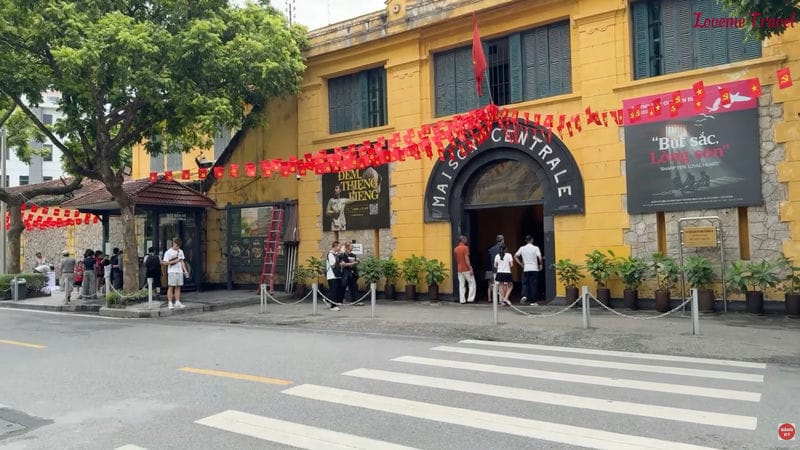
Located at No. 1 Hoa Lo Street, Hoan Kiem District, Hanoi, Hoa Lo Prison is not simply a historical site—it is an emotional experience. Known during the French colonial era as Maison Centrale, and once referred to by prisoners as “hell on earth,” Hoa Lo Prison stands as one of the most powerful reminders of Vietnam’s long and painful struggle for independence.
Visiting Hoa Lo Prison is not about ticking off another tourist attraction. It is about confronting history head-on—quietly, slowly, and with respect. From its thick stone walls to the preserved shackles, from the execution yard to the memorial altar, everything here carries weight. You don’t leave unchanged.
You May Also Like:
First Impressions: Stepping Into the Silence of Hoa Lo Prison
From the outside, Hoa Lo Prison is almost invisible to the rhythm of modern Hanoi. Motorbikes stream past in endless waves, cafés buzz with conversation, office workers hurry through their lunch breaks, and tourists drift between souvenir shops. If you didn’t know what stood behind those thick stone walls, you might walk right past it without a second glance.
That contrast is what makes entering Hoa Lo Prison so unsettling.
The moment you step through the main gate, something shifts. The noise of the city doesn’t disappear all at once—it fades, like a radio slowly being turned down. The temperature drops slightly. The air feels denser, heavier, as if it carries memories you can’t see. Even before reading a single plaque or display, you can sense that this place was designed to overwhelm the human spirit.
This emotional transition is deliberate. Hoa Lo Prison was never meant to be just a place of confinement. From its earliest days, it was built to intimidate, to dominate, and to break resistance before it could grow. Every architectural choice—from the height of the walls to the narrow corridors—was calculated.
Originally constructed in 1896 by the French colonial administration, Hoa Lo Prison was placed deliberately in the heart of Hanoi, not on the outskirts. The message was clear: power should be visible. Fear should be unavoidable. Every Vietnamese citizen passing by would know what awaited those who challenged colonial rule.
As a visitor today, walking through the same entrance once used by prisoners, you can’t help but feel the weight of that intention. Hoa Lo Prison does not shout its history. It lets the silence do the work.
Why the Name “Hoa Lo Prison” Carries Such Heavy Meaning
Before it became synonymous with suffering, Hoa Lo was simply a street name. Long before prison walls rose here, the neighborhood was known for its craftsmen—locals who made clay stoves, pottery, and earthenware. Fires burned constantly in kilns, shaping everyday objects that warmed homes and fed families.
The name “Hoa Lo” loosely translates to “fiery furnace.”
The irony is brutal.
A place once associated with warmth, creation, and livelihood became a literal furnace of endurance, pain, and resistance. Over time, Hoa Lo Prison transformed from a working neighborhood into one of the most feared prisons in French Indochina.
As you walk through the preserved grounds today, that transformation feels tangible. You’re not just moving through rooms—you’re moving through layers of history. The name Hoa Lo Prison stops feeling like a label and starts feeling like a metaphor. This was a furnace that tested the limits of the human body and mind.
For Vietnamese revolutionaries, survival inside Hoa Lo Prison was not just about staying alive. It was about preserving identity, belief, and dignity under constant pressure to surrender all three.
Practical Information for Visiting Hoa Lo Prison
Before diving deeper into the emotional experience of Hoa Lo Prison, it’s worth understanding the basics. A visit here is straightforward logistically, which makes the contrast with the site’s heavy history even more striking.
Location
Address:
1 Hoa Lo Street, Hoan Kiem District, Hanoi
(near the Hai Ba Trung – Trang Thi intersection)
The location couldn’t be more central. Hoa Lo Prison sits just minutes from Hoan Kiem Lake, surrounded by some of Hanoi’s busiest streets.
Opening Hours
8:00 AM – 5:00 PM daily
(Open on weekends; hours may vary slightly on public holidays)
Entrance Fee
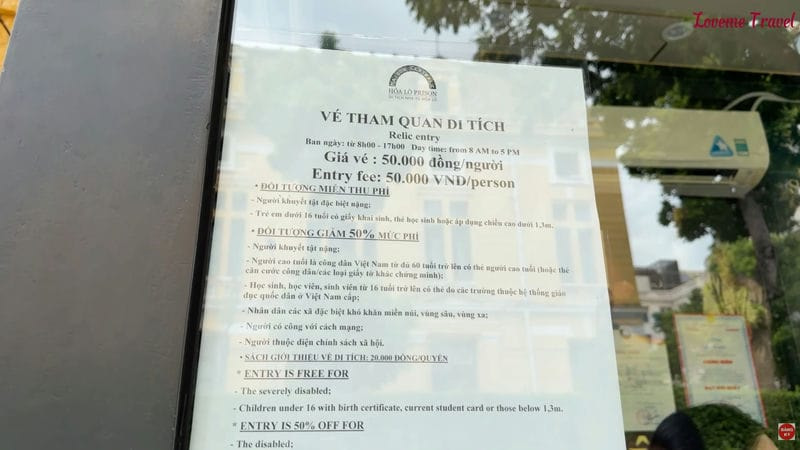
- Adults: 50,000 VND
- Students and seniors: Discounted (ID required)
- Children under 15: Free (must be accompanied by an adult)
Ideal Visit Duration
Plan to spend 1.5 to 2 hours inside Hoa Lo Prison.
Morning visits often feel calmer and quieter, allowing more space for reflection. Late afternoon visits can feel emotionally heavier as shadows stretch across the prison walls and corridors, subtly reinforcing the atmosphere of confinement.
Getting to Hoa Lo Prison: Easy Access, Heavy Destination
One of the most surprising things about Hoa Lo Prison is how accessible it is.
- On foot: A short, easy walk from Hoan Kiem Lake
- Motorbike: Parking is usually available directly outside the entrance (around 5,000 VND)
- Taxi / Ride-hailing: Grab, Be, and Xanh SM all work smoothly
- Bus routes: 02, 32, 34, and 38 stop nearby
Simply searching “Hoa Lo Prison” on Google Maps will take you directly to the entrance. The convenience almost feels inappropriate given the gravity of what lies inside—but that contrast mirrors the prison’s original purpose: to exist openly, unapologetically, in everyday life.
Visitor Etiquette: Understanding the Tone of Hoa Lo Prison
While Hoa Lo Prison functions as a museum today, it is also a memorial. That dual role shapes the expectations for visitors.
You’ll notice signs reminding guests to dress and behave respectfully—and those guidelines are there for a reason.
Key Rules to Keep in Mind
- Dress modestly (no shorts, tank tops, or revealing clothing)
- Photography is restricted in certain areas, especially memorial zones
- Do not touch artifacts or cross barriers
- Maintain silence in remembrance areas
- Keep the site clean and orderly
This is not a place for playful poses or casual selfies. Hoa Lo Prison asks for something different from its visitors: presence, patience, and respect.
Many travelers describe feeling an instinctive urge to lower their voices once inside. The space itself encourages reflection.
The Emotional Weight of Walking Through Hoa Lo Prison
What makes Hoa Lo Prison so powerful isn’t just the historical information—it’s the way the environment communicates without words.
The thick stone walls seem to absorb sound. Corridors feel narrow, even when they’re not. Light enters sparingly, often from high, unreachable windows. You begin to understand how architecture was used as a psychological weapon.
As you move deeper into Hoa Lo Prison, displays reveal how overcrowded conditions became. Cells designed for a handful of prisoners often held dozens. Shackles and restraints line the floors, forcing bodies into unnatural positions for hours or days at a time.
And yet, alongside the suffering, Hoa Lo Prison also tells a story of resilience.
Hidden messages, handmade tools, and accounts of secret political education sessions reveal how prisoners resisted in the only ways they could. Even under constant surveillance, they found ways to teach, to organize, and to maintain hope.
This duality—oppression and resistance—defines the emotional core of Hoa Lo Prison.
A Space That Refuses to Be Forgotten
Leaving Hoa Lo Prison is a strange experience. The moment you step back onto the street, Hanoi rushes in again—horns, voices, movement, life. It feels almost too loud.
Many visitors find themselves pausing outside the gate, needing a moment to recalibrate. The visit lingers. You don’t just walk away from Hoa Lo Prison with facts or photos. You carry a weight, a quiet awareness of how recent this history really is.
In a city that’s rapidly modernizing, Hoa Lo Prison stands as a reminder that progress is layered over pain, sacrifice, and endurance. It refuses to let the past fade quietly into textbooks.
For travelers seeking more than surface-level sightseeing, Hoa Lo Prison offers something rare: an experience that challenges, educates, and humbles all at once.
Behind the Four-Meter Walls: Architecture Designed for Absolute Control
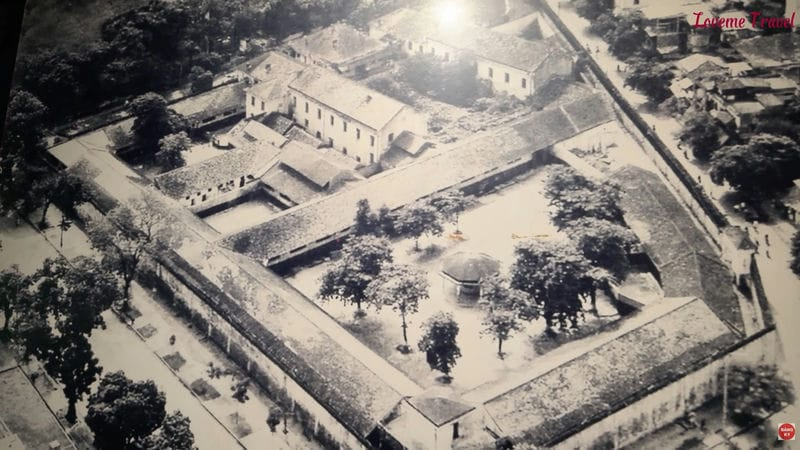
One of the most disturbing aspects of Hoa Lo Prison is not a single artifact or photograph, but the building itself. The architecture of Hoa Lo Prison was deliberately designed as an instrument of domination. Every wall, corridor, door, and shadow served a clear purpose: control, isolation, and psychological breakdown.
The prison’s exterior walls rise more than four meters high, forming an intimidating barrier between the inside world of punishment and the outside world of ordinary life. Embedded along the top are shards of broken glass and coils of barbed wire, ensuring that even the most desperate escape attempt would result in severe injury or death. These walls are not merely tall—they are thick, reaching up to half a meter in width. This thickness blocked sound, prevented communication, and reinforced the feeling that once inside Hoa Lo Prison, a prisoner had been completely erased from society.
Ventilation was intentionally minimal. Narrow slits placed far above eye level allowed only small amounts of air and light to enter the cells. These openings offered no view of the outside world—only a reminder that freedom existed somewhere beyond reach. Heavy iron doors and reinforced wooden gates, some weighing hundreds of kilograms, sealed each space with brutal finality. The architecture ensured that prisoners were isolated not only physically, but mentally and emotionally as well.
Hoa Lo Prison was not simply a place of confinement. It was a machine engineered to wear down the human spirit.
The Main Gate: Where Identity Was Stripped Away
The main gate of Hoa Lo Prison is constructed from thick laterite stone, its surface rough and unyielding. Above the entrance, carved into the stone, are the words Maison Centrale—the French colonial name for the prison. This inscription remains today as a chilling symbol of colonial authority and dominance.
For prisoners, passing through this gate marked the end of their previous lives. Inside the reception area, new arrivals were systematically stripped of all personal belongings. Clothes were removed, jewelry confiscated, and any items that hinted at individuality were taken away. Names, too, were erased. Prisoners were assigned numbers, which became their only recognized identity within the prison system.
This process was not accidental or bureaucratic—it was psychological warfare. By reducing people to numbers, Hoa Lo Prison sought to destroy personal identity, dignity, and resistance from the very first moment of incarceration.
Zone A: The Harsh Reality of Common Prisoners
Zone A was designated for common prisoners, many of whom were accused of minor offenses or acts deemed threatening to colonial order. These detention rooms were overcrowded, suffocating, and relentlessly harsh.
Cells often held between twenty and thirty prisoners in spaces never designed for such numbers. There were no beds, no pillows, and no blankets. Prisoners slept directly on cold cement floors, often chained together at night to prevent movement. Hygiene was nearly nonexistent, and disease spread easily in the damp, poorly ventilated rooms.
Forced labor was routine. Prisoners were beaten for minor infractions, exhaustion, or simply to instill fear. Food rations were minimal and of poor quality, designed to sustain life but sap strength. Yet even in these conditions, survival often depended on solidarity—sharing scraps of food, whispering encouragement, or silently supporting one another through suffering.
Zone B: Political Prisoners and the Birthplace of Resistance
Zone B represents the spiritual and ideological heart of Hoa Lo Prison. This section held political prisoners—Vietnamese revolutionaries, intellectuals, and activists who opposed French colonial rule. Many of them would later become central figures in Vietnam’s independence movement.
Conditions in Zone B were deliberately harsher. Prisoners were kept in permanent leg shackles, restricting movement day and night. Daylight was limited, surveillance constant, and punishment severe. The colonial authorities believed that political prisoners posed the greatest threat and required the strictest control.
Ironically, this is where resistance flourished most strongly. Despite constant monitoring, prisoners found ways to educate one another. They whispered political theory, shared news from the outside world, composed revolutionary poetry and songs, and even organized secret escape plans. The chains on their bodies could not restrain their ideas.
Zone B stands today as a powerful reminder that oppression often produces the very resistance it seeks to eliminate.
Zone C: The Execution Chamber and the Guillotine
Among the most haunting areas of Hoa Lo Prison is Zone C—the execution section. Here, the French colonial authorities carried out death sentences, often with chilling efficiency.
The guillotine, imported directly from Europe, remains preserved as a silent witness to these executions. Prisoners condemned to death were isolated the day before their execution. They were denied visitors, given limited food, and kept under strict silence. Psychological torment accompanied physical confinement, as prisoners were left alone with the knowledge of what awaited them.
Executions were conducted within the prison grounds. Bodies were buried nearby, often in unmarked graves, without ceremonies, names, or acknowledgment. Standing in this room today, visitors often feel an overwhelming sense of injustice and grief—a heavy silence that speaks louder than words.
The Dark Cell: Solitary Confinement and Psychological Destruction
Hidden underground lies one of the most terrifying spaces in Hoa Lo Prison: the dark cell. Reserved for prisoners considered especially dangerous or defiant, this area was designed for complete psychological annihilation.
The dark cell has no windows and no natural light. Soundproof walls eliminate external noise, creating an environment of absolute isolation. Prisoners were confined alone, sometimes for weeks or months, with no sense of time. Day and night blurred into an endless void.
Many prisoners lost their ability to track reality. Some suffered hallucinations; others experienced severe mental breakdowns. This space represents the most extreme form of control exercised within Hoa Lo Prison—a place where the mind itself became the battlefield.
The Women’s Detention Area: Suffering and Silent Strength
The women’s section of Hoa Lo Prison was smaller and more isolated, yet no less brutal. It was deliberately positioned near male torture zones so that female prisoners could hear screams during interrogations—a calculated form of psychological intimidation.
Cells were damp, dark, and poorly ventilated. Prisoners were given torn mats to sleep on and forced to share bucket toilets without privacy. Food was often rotten, water scarce, and medical care virtually nonexistent. Although women were not always shackled like male prisoners, constant surveillance replaced physical restraints.
Despite these conditions, many female revolutionaries displayed extraordinary resilience. Their endurance stands as a testament to the often-overlooked role women played in Vietnam’s struggle for independence.
Guard Quarters: A Disturbing Contrast
Beyond the prison cells lay the guard quarters and administrative zones. These areas were cleaner, quieter, and unsettlingly ordinary. Guards had access to better food, rest areas, and even a small pond where they washed clothes—and reportedly cleaned execution blades.
The contrast between the suffering of prisoners and the relative comfort of guards is stark and deeply unsettling. It highlights the moral divide at the heart of Hoa Lo Prison and reinforces the dehumanizing nature of the colonial system.
Exhibition Areas: Evidence of Cruelty and Resistance
Today, Hoa Lo Prison functions as a museum, preserving artifacts that tell the story of both cruelty and courage. Exhibitions include:
Artifacts of Prisoner Life
Coarse uniforms, bowls, spoons, and water containers illustrate daily survival. Handmade items such as wooden combs, bamboo toothbrushes, and improvised sewing tools demonstrate ingenuity under extreme conditions.
Shackles and Restraints
Wooden and iron leg shackles, fixed floor restraints, and original solitary confinement equipment show how control was enforced physically.
Torture Instruments
Whips, ropes, iron rods, and reconstructed torture setups are displayed based on historical records, offering sobering insight into interrogation methods.
Documents and Photographs
Mugshots, prison records, verdicts, and architectural maps provide historical context and human faces to the stories told within these walls.
The Memorial Area: Remembering the Fallen
The memorial zone is the most solemn space in Hoa Lo Prison. An altar displays photographs, incense, and candles. Names of fallen prisoners are engraved into the walls. Visitors may light incense as a sign of respect.
Silence here feels natural, not imposed. It is a space for remembrance, reflection, and quiet acknowledgment of sacrifice.
Emotional Impact: Why Hoa Lo Prison Lingers in Memory
What makes Hoa Lo Prison unforgettable is not shock or spectacle—it is emotional weight. The cold stone walls, rusted shackles, narrow cells, and preserved silence combine to create an experience that stays with visitors long after they leave.
This place does not glorify suffering. Instead, it honors endurance, resilience, and the human capacity to resist injustice.
Final Reflections: Is Hoa Lo Prison Worth Visiting?
Without hesitation, yes.
Hoa Lo Prison is essential for anyone seeking to understand Vietnam beyond surface-level impressions. It is not an easy place to visit, but it is a necessary one. If you wish to understand Vietnam’s fight for independence, the true cost of colonialism, and the strength of the human spirit under oppression, Hoa Lo Prison deserves your time and respect.
Walk through it slowly. Reflect deeply. And leave with a greater understanding of history written not just in books—but in stone, silence, and memory.